

Collection
The collection of the University of Warsaw Herbarium comprises approximately 750,000 specimens and historical objects. It is organized into three main sections: the Scientific Collection, the Teaching Collection, and the Historical Collection.
Scientific Collection
The Scientific Collection is the core research resource of the University of Warsaw Herbarium and includes (divided into organism groups):
Vascular plants
Approximately 500,000 specimens. Nearly half of the vascular plant holdings date from the 19th century. The oldest sheets are dated to the 1820s and consist primarily of specimens collected by the founder of the Warsaw herbarium, Michał Szubert. A large body of herbarium material was left by Edward Strasburger, who obtained specimens mostly in 1863 from the University of Warsaw Botanic Garden, creating documentation of the species richness of the garden and greenhouses of that time. The Herbarium holds many sheets of Flora Polonica Exsiccata, a publication founded in 1893 by Antoni Rehman and Eustachy Wołoszczak, whose aim was to study the entirety of Poland’s flora.
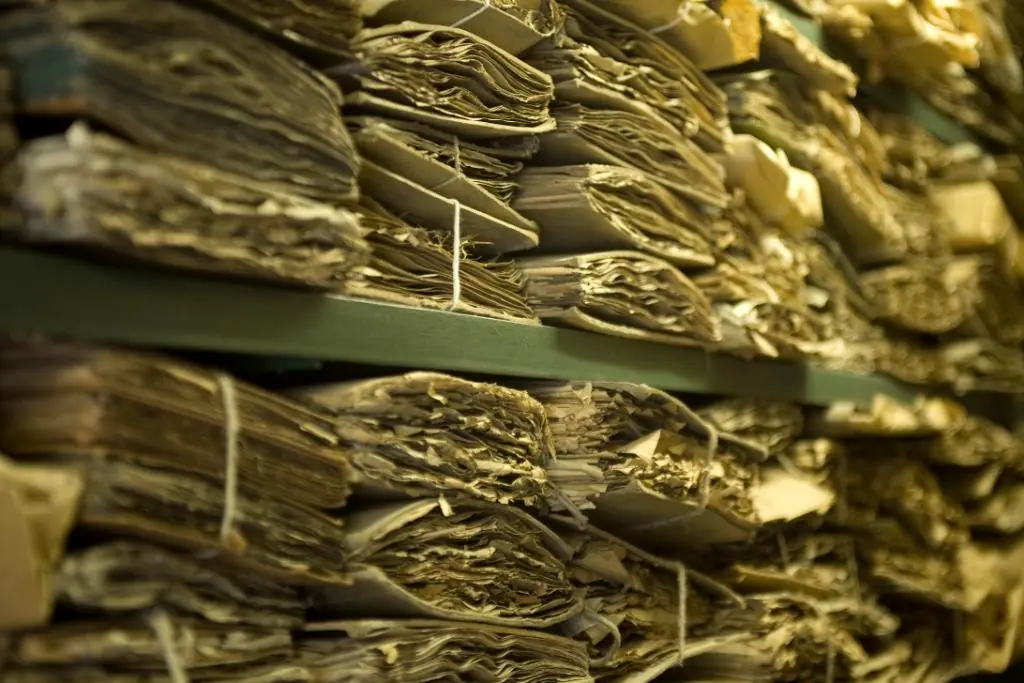
The vascular plant collection is organized into three sets: Herbarium Generale (approx. 300,000 specimens), Flora Polonica (approx. 100,000 specimens; a fully digitized collection made available in GBIF), and unprocessed collections (materials awaiting full arrangement and incorporation into the main collections). Herbarium Generale and Flora Polonica are arranged according to the Engler and Prantl system; work is underway to merge both sets and arrange them according to the APG system.
Separate collections (i.e., collections not planned to be incorporated into the core collection): a collection of over 5.2 thousand sedge (Carex) sheets by Wilhelm Lackowtiz, digitized.
Unprocessed collections include specimens collected by: Michał Szubert – mainly from the University of Warsaw Botanic Garden; Władysław Matuszkiewicz – from the vicinity of Lviv, the Sudetes, and the Białowieża Forest; Ferdynand Karo – from Poland and Siberia (the University of Warsaw Herbarium holds the largest collection in the world of plants collected by Ferdynand Karo; the collection consists of over 1,500 species collected in 1866–1913 in Poland as well as in Siberia and the Far East, including a dozen or so types and syntypes); Tadeusz Wiśniewski – from Scandinavia, the Caucasus, and the Balkans; Roman Kobendza – mainly from the Kampinos Forest; Hanna Czeczott – the genus Quercus from Europe and the Canary Islands; Stefan Krupko – Cyprus, Jerusalem; Bolesław Hryniewiecki – from Europe; Zygmunt Pietkiewicz – Ukraine (vicinity of Kyiv), the Caucasus, the Carpathians; Franciszek Błoński – from Eastern Ukraine; Bernhard Kruse – from Europe; Wacław Gajewski – the genus Geum for genetic research; Ernst Holzfuss – from Western Pomerania.
Bryophytes
The main bryophyte herbarium comprises approximately 18.5 thousand specimens. The whole is divided into: mosses (about 9.8 thousand specimens, excluding peat mosses), peat mosses (about 1.5 thousand specimens), and liverworts (about 5.5 thousand specimens). Bryophytes are mostly stored in packets, less often mounted on sheets, and the smallest are preserved as microscopic preparations. In addition to the main herbarium, more than a dozen separate collections and an extensive set of still-unprocessed materials have been preserved.
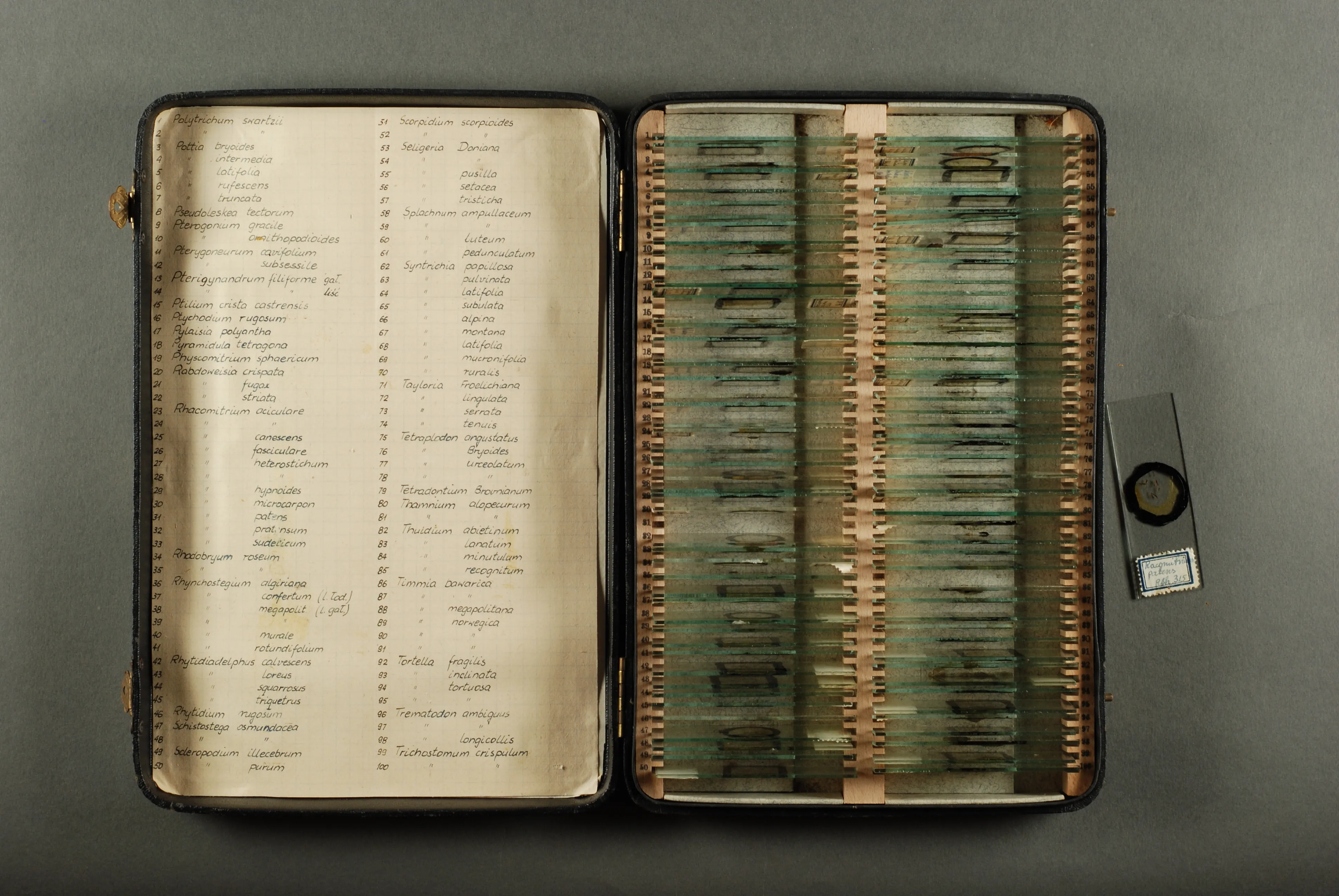
Bryophytes from the 19th and early 20th century were amassed to a large extent thanks to the efforts of Tadeusz Wiśniewski, who carried out intensive herbarium exchange with other collectors. Among the materials acquired at that time are, among others, specimens collected by Hiacynt Łobarzewski in the 1840s in the Tatra Mountains and the Eastern Carpathians, as well as Wiśniewski’s rich personal collection, assembled inter alia for Bryotheca Polonica, continued after Antoni Żmuda. Materials by Karolina Lubliner (especially peat mosses) have also been preserved from the same period.
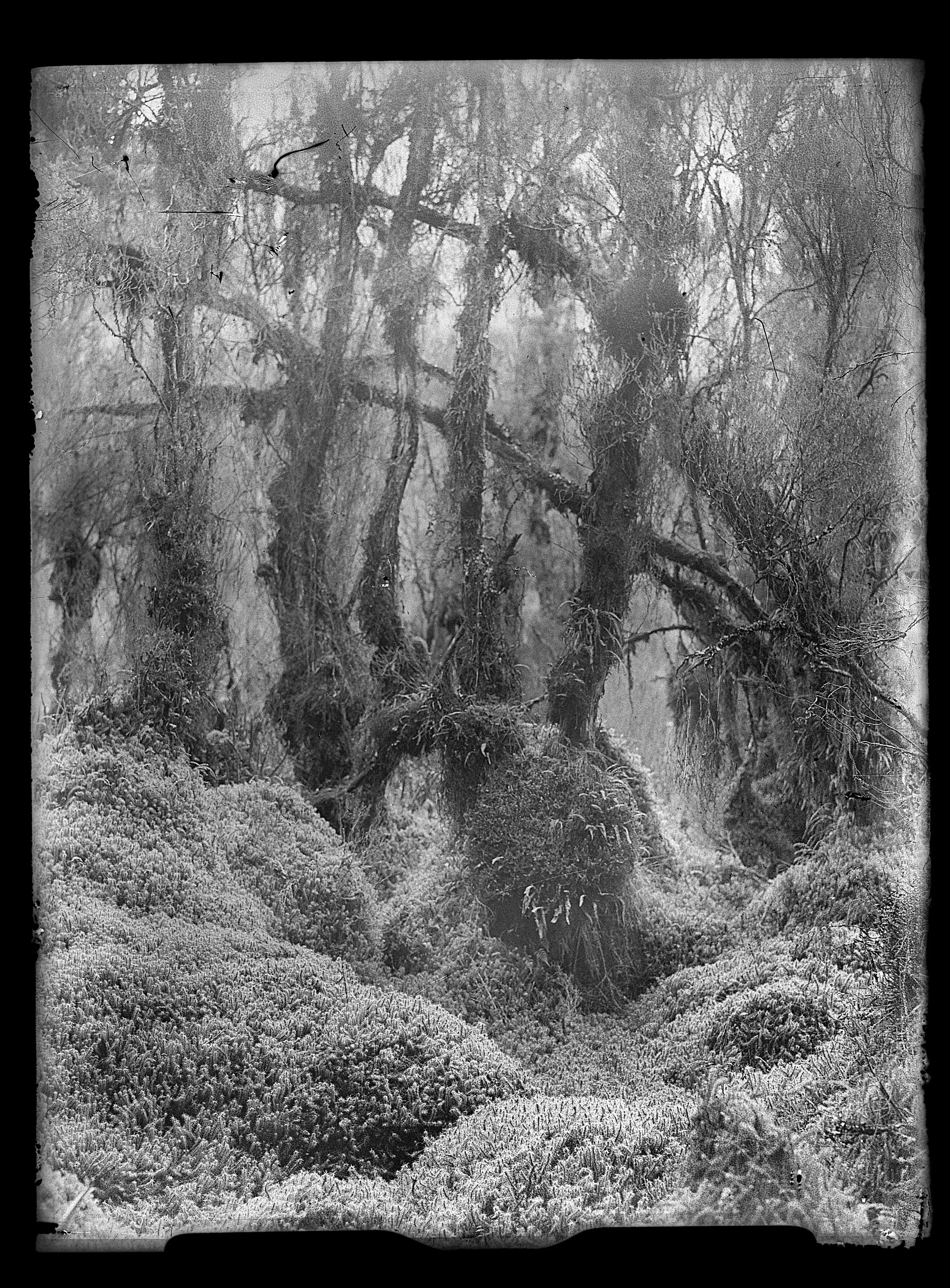
The bryophyte collection expanded significantly after World War II along with the development of bryology at the Department of Plant Systematics and Geography of the University of Warsaw. Most Polish species come from the Suwałki Region and central Poland, where research was conducted mainly by Irena Rejment-Grochowska, Dygna Sobotka, and Jadwiga Mickiewicz. Materials were also acquired through exchange with other herbaria (including from Belgium, Denmark, Finland, Iceland, Canada, and Ukraine).
Separate collections include sets of exsiccata publications and thematic collections, including: Bryotheca Europaea by Ludwig Rabenhorst (1858–1876; 27 fascicles comprising 1,350 species, with minor gaps, and 22 duplicate fascicles), Hepaticae Europaeae by Rabenhorst and Gottsche (1855–1879; 660 sheets in 32 booklets), the herbarium of Tatra mosses and liverworts by Tytus Chałubiński (approx. 800 specimens, with gaps), volumes of Collectio Muscorum and Collectio Hepatici by Józef Krupa, Bryotheca Polonica (4 fascicles by Antoni Żmuda and a fifth prepared by Tadeusz Wiśniewski), Musci Polonici by Franciszek Błoński (collected during excursions around Warsaw and to the Białowieża Forest in 1887–1888), Sammlungen deutcher Laubmoose, Lebermoose und Flechten by D. Dietrich of Jena (2 folders), Cryptogamen-Herbarium (published in Bielefield by H. Wagner in 1854–1856), and a set of 443 sheets with bryophytes from Germany and the Polish–German borderland by H. Mainitz from 1930–1942, supplemented with drawings.
Unprocessed collections include specimens collected, among others, by: Tadeusz Wiśniewski – from Africa, the Caucasus, Bulgaria, Spitsbergen, Volhynia, Podolia, and the Eastern Carpathians, as well as mosses collected for Bryotheca Polonica (mainly from the Tatras); Irena Rejment-Grochowska – mainly from the Silesian Beskids; Jadwiga Mickiewicz – from various places in Poland; Karolina Lubliner – from various places in Poland; Roman Kobendza – mainly from the Kampinos Forest; Antoni Rehman – from Volhynian Polesia; Z. Bielecka – from the Suwałki Region; Ludmiła Goetzen (later Hausbrandt) – from Sokołów County and from Ukraine; Antoni Żmuda – from the vicinity of Kraków and the Pieniny Mountains; Władysław Matuszkiewicz – from the Białowieża Forest; Hiacynt Łobarzewski – from the Carpathians; Tytus Chałubiński – from the Tatras; Franciszek Błoński – from the Świętokrzyskie Mountains and surrounding areas. In addition to the collections of the persons listed above, the archive contains individual packets from many other collectors; in some cases it was not possible to determine the author of the collection.
Fungi and lichens
Fungi are a richly represented group in the University of Warsaw Herbarium – their number is estimated at about 35 thousand specimens. In the past, researchers were most interested in macroscopic fruiting-body fungi and parasites of economically important plants, and this type of fungi is most abundant in the herbarium.
The first mycological collection of the Herbarium was a 19th-century set by Franciszek Błoński from the vicinity of Warsaw. This researcher conducted lively exchange of materials, which gradually expanded Warsaw’s resources. Specimens of Polish parasitic fungi also arrived through exsiccata publications, especially the booklets of Mycotheca polonica, compiled by Marian Raciborski and later by Bolesław Namysłowski (from specimens collected personally and by other researchers: Leon Nowakowski, Kazimierz Rouppert, Tadeusz Wilczyński, and Antoni Wróblewski). Specimens from similar publications, incomplete or fragmentary, were incorporated into the main collection.
Until the outbreak of World War II, the mycological part of the Herbarium was small. The greatest increase in specimens occurred in 1950–1980 with the development of the mycological laboratory at the Department of Plant Systematics and Geography headed by Prof. Alina Skirgiełło and thanks to cooperation with scientific institutions in Poland. In the late 1960s, the State Institute of Rural Economy in Bydgoszcz donated to the Herbarium a collection of phytopathogenic fungi by Andrzej Michalski (preserved as a separate collection), and in 1982 Nicolaus Copernicus University in Toruń donated a set prepared by Wanda and Jan Zabłocki (over 700 specimens, incorporated into the main collection). Intensive work by Alina Skirgiełło, Alicja Borowska, and Wanda Rudnicka-Jezierska on volumes of Flora Polska – Grzyby (Fungi) resulted in further collections and exchange with Finland, Denmark, Czechoslovakia, Belgium, Canada, and Sweden.
In the 21st century, the attention of mycologists employed in the Department has been drawn to microscopic fungi, including endophytic fungi. As part of the research of Marta Wrzosek and Julia Pawłowska (née Budziszewska), the Herbarium gained new fungal specimens, including species new to science, stored in tubes or Petri dishes.
Separate collections include Herbarium mycologicum (8 booklets, numbers 1–800) and Fungi europaei, series 2 (11 booklets, numbers 1–1200, missing booklet 201–300) by Ludwig Rabenhorst; Fungi Varsovienses exsiccati by Franciszek Błoński (4 fascicles from 1884 onward); Funghi parassiti delle piante coltivate od utili by Giovanni Briosi and Fridiano Cavara (19 fascicles, 1888–1926); the Collection of “parasitic” Polish fungi (original spelling preserved) from 1890–1891 (2 fascicles by Marian Raciborski); Mycotheca polonica from 1909–1910 (3 parts; a total of 150 species; the second and third booklets – 2 copies each; a total of 150 species published in the journal “Kosmos” nos. 34 and 35); herbaria of parasitic fungi from Pomerania by Johann Winkelmann (approx. 400 specimens; transferred after World War II from the Natural History Museum of the City of Szczecin); Diseases of cultivated plants by W. Siemaszko and L. Kaznowski (1926–1929; 2 booklets, 45 specimens in total, and duplicate booklets); a small set from Puławy by Józef Trzebiński (1925) and the collection of phytopathogenic fungi of Greater Poland by Andrzej Michalski.
Unprocessed collections are few – awaiting study are part of Andrzej Michalski’s parasitic fungi collection (from Vilnius and Bydgoszcz) and a small collection of parasitic fungi by Lucjan Pietkiewicz from 1886 (from Ukraine).
Lichens (lichenized fungi) form a separate, though not very extensive collection estimated at about 3 thousand specimens. Few objects date from the 19th century; one of the oldest specimens is Ramalina farinacea with an undated label prepared by Michał Szubert. Other 19th-century specimens collected in the Kingdom of Poland and Galicia are vouched for by Feliks Berdau, Julian Steinhaus, Jan Sznabl, Franciszek Błoński, and Bogumir Eichler.
Foreign pre-war lichen collections come mainly from Dorpat and the Chornohora range (among others thanks to Jan Muszyński and Antoni Rehman). In the interwar period the collection was expanded by Janina Stankiewiczówna (materials for a doctoral dissertation from the Kielce–Sandomierz Upland, 1925–1928) and Roman Kobendza, who conducted research in the Kampinos Forest. Specimens from the publication Lichenotheca Polonica were also incorporated into the main collection (including fascicle I from 1930 – 50 species from Poznań prepared by Feliks Krawiec, and fascicle III from 1952 – 50 species from the Stołowe Mountains prepared by Zygmunt Tobolewski).
After World War II, intensive lichen research in Warsaw was carried out by Dr Janina Zielińska. Her collection from the Kampinos Forest, the Borecka Forest, and the Ełk Lakeland is exceptionally valuable. The most recent acquisition is 304 specimens from Brudzeń Landscape Park, deposited in the Herbarium in 2012 by Piotr Zaniewski.
Unprocessed collections include rock-dwelling lichens of Dr Teresa Węgleńska collected in Antarctica, as well as lichens collected by Roman Kobendza in the Tatras and the Białowieża Forest.
Algae
Algae are sparsely represented in the University of Warsaw Herbarium. The entire set consists of the main collection of about 4 thousand specimens and several separate collections. The main collection originates from various years and includes primarily algae from the territory of Poland, as well as a few specimens obtained through exchange or purchased.
The oldest is a card by Michał Szubert from 1824 depicting the stonewort Chara flexilis. Among older specimens are also algae brought by Józef Rostafiński from trips to Cherbourg and Antibes (France, 1874–1878), by Franciszek Błoński from the vicinity of Ciechocinek, by Jan Muszyński from the vicinity of Dorpat (now Tartu), by Józef Łagowski from Siberia, by Lucjan Pietkiewicz from the vicinity of Kyiv, and by Bolesław Hryniewiecki from Norway. A very large part of the holdings is owed to Maria Magdalena Rogalska (a student of Hryniewiecki), who studied algae of the Suwałki Region in the 1930s; part of her materials burned during the Uprising, and the remaining herbaria were damaged.
The richest part of the algal herbarium holdings consists of brown algae, especially from the orders Fucales and Laminariales. There are relatively few microscopic algae, which is related to the need for different preparation of the material (e.g., embedding in synthetic resin, permanent microscope slides, with attached drawings and descriptions). The Herbarium acquired such specimens – including types of newly described species – thanks to the work of Dr Hanna Szymańska (working on Oedogoniales and Coleochaete of the Suwałki Region) and Prof. Bożena Zakryś (studying euglenids).
Separate collections include Die Algen Sachsens (Rabenhorst; Dresden 1848–1877; 252 booklets and a total of 2586 sheets with gaps, including missing no. 2241–2260, 2281–2310, 2521–2586); Die Characeen Europa’s (Braun, Rabenhorst, Stizenberger; 1857–1878, 5 booklets and 121 sheets); a cyanobacteria collection by Józef Rostafiński (the oldest from the 1830s); three folders of Polish algae (two prepared by Marian Raciborski, the third with the participation of Jadwiga Wołoszyńska; 150 species published in “Kosmos” in 1910–1911); brown algae and red algae from the Atlantic Ocean off the coast of France (1930; Hanna Wysocka, 140 sheets); an algae collection from the island of Helgoland (1902, 114 sheets); Charotheca Polonica: Herbarium of Stoneworts of Poland (no. 1–20; stoneworts of Greater Poland; Izabella Dąmbska); Phykotheca marchica (Paul Hennings; 1893, fascicle I with 50 specimens); Algae Boreali-Americanae (F. S. Collins, one booklet, while other specimens by this author were incorporated into the main collection).
Slime molds
The slime mold collection comprises 250 specimens. Until World War II, slime molds were kept in the Herbarium together with fungi. The oldest herbarium materials are signed by Jerzy Alexandrowicz and Leon Nowakowski and date to the 1870s. The largest number of packets containing organisms of the class Myxomycota was supplied by the Slovak Andrej Kmet – these are slime molds collected at the foothills of the Ore Mountains (Rudawy) in Brandenburg. Other specimens come, among others, from the collections of Franciszek Błoński from the Białowieża Forest and from materials of A. Skirgiełło and A. Borowska.
Single specimens by Thümen and Rabenhorst are remnants of destroyed, more substantial slime mold folders. The last specimens were acquired in the 1970s through exchange with Finland.
Teaching Collection
The Teaching Collection is a library of approximately 500 items that is continuously growing, consisting of selected specimens intended for use during classes. Specimens are chosen so as to illustrate the topics discussed as clearly as possible, and are then specially protected to make them less susceptible to damage than objects from the Scientific Collection. Some materials are supplemented with detailed explanations of visible morphological features and their significance in environmental adaptations. The collections have a thematic arrangement (e.g., aquatic plants, carnivorous plants, desert plants).
New specimens enter the Teaching Collection in two ways: some are prepared specifically for this purpose (Dr hab. Halina Galera deserves particular credit here, as she regularly enriches the Herbarium with very carefully prepared specimens), and some are selected from the main collection when their scientific value is limited due to gaps in documentation (e.g., missing date or precise collection locality).
Historical Collection
The Historical Collection includes objects that are not classic herbarium specimens, as well as selected classic collections that were not incorporated into the core Scientific Collection due to their particular historical value (e.g., related to the collector, the form of preparation, or the history of the object); some information about these collections is also indicated in the description of the Scientific Collection, while the Historical Collection objects themselves are stored in a specially secured place preventing unwanted access.
General botanical collections include seed plants, as well as ferns, bryophytes, fungi, and algae, which were formerly treated collectively as “cryptogams”.
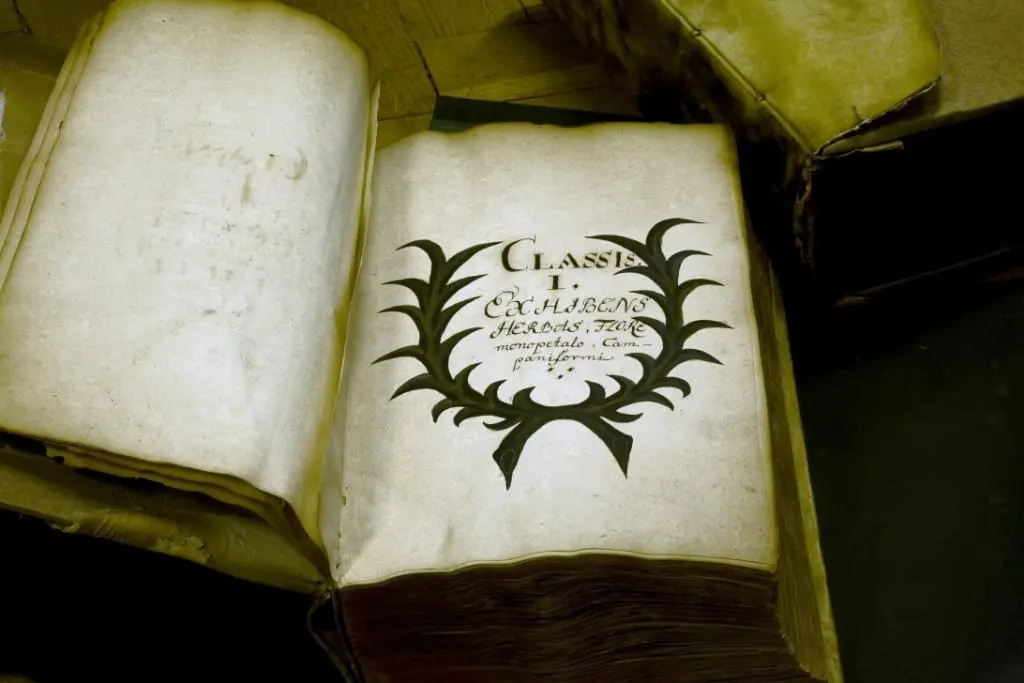

First half of the 18th century – Herbarium vivum – Maciej Ernest Borecki (Boretius) in cooperation with Jerzy Andrzej Helwing – one of the oldest herbaria preserved in Poland with dried plants; of five volumes, four have survived (I, II, IV, V), bound in parchment and bearing traces of damage, most likely after a fire; most of the 944 plants are preserved in good condition, and the arrangement corresponds to Tournefort’s pre-Linnaean classification system; at the end of volume V there is an index of Latin, German (Gothic), and Polish names; the whole is digitized and made available upon request addressed to the head of the Herbarium WA.
1806 – Teutsches Herbarium I centurie – Bertuch – a fascicle-based herbarium (exsiccata) series of general scope.
1815–1818 – Deutschlands Schwaemme in getrockneten Exemplaren – C.F. Holl, J.C. Schmidt; J.C. Schmidt, G. Kunze – a series of “dried specimens” of fungi prepared for comparison and documentation.
c. 1820 – Chara + Algae – Alexander Braun or Karl Julius Fritzsche – a collection concerning stoneworts and algae, prepared as comparative material.
1832–1889 – the collection of F. Błoński, from his own specimens, Alexandrowicz, and others – Błoński – a set of cryptogamic materials gathered over many years, also including specimens acquired through exchange.
1853–1854 – Pflanzen aus Sud. Afrika – Breutel Johann – a collection of plants from South Africa.
1854–1857 – Cryptogamen-Herbarium (Laubmoose (mosses); Lebermoose (liverworts); Flechten (lichens); Algen; Pilze und Gefass-Cryptogamen (fungi and ferns)) – Hermann Wagner – a multi-part cryptogam series combining several organism groups within one publishing concept.
1855–1858 – Gras Herbarium – Wagner Hermann – a thematic collection (grasses and sedges) in herbarium arrangement.
1856 – Sammlung deutscher Laubmoose, Lebermoose und Flechten (Collection of German mosses, liverworts and lichens) – Dr. D. Dietrich – a cryptogam series preserved as loose sheets in wrappers.
1867 – Plantes des Pyrenees – M. Fourcade – a collection of plants from the Pyrenees in herbarium form.
1877–1886 – Collectio Muscorum – Józef Krupa – volumes/booklets with bryophytes forming a coherent comparative collection.
1883 – Botanisches Album aus dem Riesengebirge – W. Winkler – an album/collection documenting plants from the Karkonosze region.
1886 – Fungi Varsovienses exsiccati – Fr. Błoński – a series of fungal specimens (exsiccata) from Warsaw and its vicinity.
1887 – Musci Polonici – Fr. Błoński – a small series of bryophytes collected in Poland.
c. 1890 – Musci collected by Walenty Łękawski and identified – Walenty Łękawski – a bryophyte collection with preparation/identification.
1893 – Phykoteca marchica – Paul Hennings – an algae collection in the form of a publication/booklet.
1898 – cryptogams – Zdzisław Kłossowski – a documentary collection referring to “cryptogamic” plants in a historical approach.
19th century – H. Wagner’s Alpen-Pflanzen – Wagner Hermann – a series of alpine plants; Phanerogamen Herbarium – Wagner Hermann – a vascular plant herbarium in series form; Flora indigena = Native flora – probably Aleksander Matuszewski – a collection referring to the “native” flora; Sammlung deutscher Laubmoose – author unknown – a bryophyte collection; Flora des Riesengebirges – author unknown – a collection of plants from the Karkonosze region; a collection of mosses in a box – author unknown – loose sheets with bryophytes (including peat mosses), with basic field information.
1910 – Mycotheca Polonica – Marian Raciborski – preserved parts 2–3 (and duplicates) with parasitic fungi materials.
1911–1930 – Bryotheca Polonica – A.J. Żmuda – a fascicle-based exsiccata publication of bryophytes.
1912 – Herbarium of Tatra plants – Plantae Tatrorum exiccatae – Konstanty Stecki – a series of plant specimens from the Tatras in the form of an exsiccata publication.
1943–1946 – Herbarium – Sten Hedlung – a herbarium collection from the mid-20th century.
Ethnobotanical and utilitarian collections
1798–1898 – Centennial Herbarium after St. Karol Kłossowski – Kłossowski Karol and Zdzisław – a historical herbarium collection of high documentary value.
1861 – Arznei und giftgewaechse – Wagner Hermann – a collection of medicinal and poisonous plants (thematic collection).
1882–1883 – Medicinal herbs – Michał Fedorowski – two volumes devoted to medicinal plants and their uses.
1883 – Useful plants – Michał Fedorowski – a work concerning useful plants.
Turn of the 19th/20th century – Lithuanian herbarium – Michał Fedorowski – materials related to fieldwork and the region; Fedorowski’s notebook – Michał Fedorowski – notebook/working materials; Folk names of plants – Michał Fedorowski – 10 volumes documenting folk nomenclature.
1888–1926 – I Funghi Parassiti (Parasitic fungi) – Giovanni Briosi, Fridiano Cavara (later also Gino Polacci) – a long-running publishing series devoted to parasitic fungi of plants.
1890–1891 – Collection of parasitic Polish fungi – Marian Raciborski – a series of parasitic (phytopathogenic) fungi in the form of an exsiccata publication (original spelling of the title preserved).
1926–1929 – Diseases of cultivated plants. Herbarium – W. Siemaszko, L. Kaznowski – a phytopathological set documenting diseases of cultivated plants.
Watercolors, drawings and illustrations
19th century – Iconotheca – a collection of about 300 prints (lithographs and engravings) taken from 19th-century botanical books and journals, probably assembled by Prof. Hryniewiecki; the state of preservation is very good, and most objects are mounted in passe-partout. The core of the collection consists of color plates from Pomologie française (A. Risso, P. Poiteau; 1846) – 131 prints depicting fruit varieties along with morphological details. A large share is also formed by prints from Sertum botanicum. Collection choisie de plantes (62), Hortus Berolinensis sive icones et descriptiones (23), Flora Londinensis (18), Botanists Repository… (18), and Edwards’s Botanical Register (14 in total). The remaining part of the iconotheca is more dispersed: single plates from many different botanical publications (including, among others, mycological materials and ornamental plants).
1884–1889 – Watercolors of algae from Kyiv – Ludwik Pietkiewicz – a set of illustrations documenting algae.
1905–1908 – Watercolors of fungi – Jerzy Pietkiewicz (1893–1923) – mycological illustrations kept as historical objects.
1930 – Postcards – author unknown – a set of postcards from Monaco (iconographic materials related to the algae collections); publisher: Musée océanographique de Monaco.
1960s – Ink drawings – Maria Strasburger – documentary drawings depicting Rubus and Rosa from the vicinity of Busko-Zdrój.
In order to use our collection please contact: herbarium@uw.edu.pl